What website development really involves
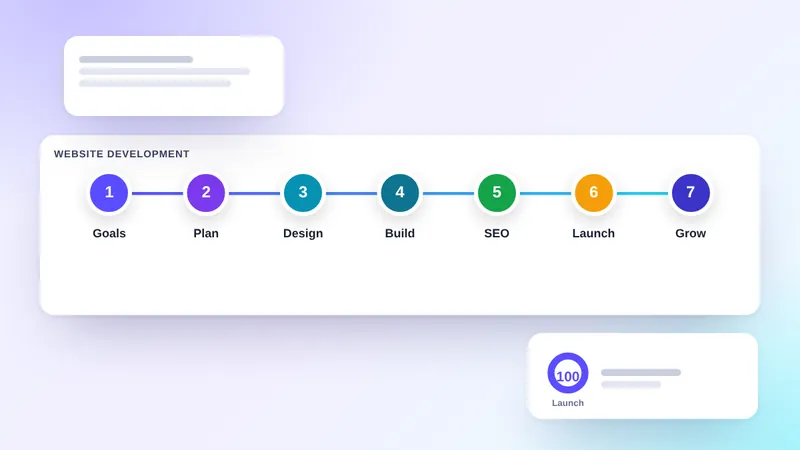
Website development is the end-to-end process of planning, designing, building, launching and maintaining a website. For a business, it isn't just a technical exercise — it's how you translate your offer, your expertise and your customers' needs into an experience that earns trust and prompts action.
A modern website project typically brings together several disciplines: strategy (what the site must achieve), information architecture (how content is organized), UX and visual design (how it looks and feels), front-end and back-end development (how it works), content (what it says) and technical SEO (how it's found).
Start with goals, audiences and success metrics
Before choosing colours or platforms, answer three questions:
- Who is the site for? Define your main audiences and what each needs to know before they act.
- What should they do? Pick one primary conversion (for example, request a quote) and a few secondary ones (subscribe, download, call).
- How will you measure success? Agree metrics such as qualified enquiries per month, conversion rate or organic traffic to key pages.
These answers drive every later decision — from navigation labels to which pages get the most design attention.
Plan your sitemap and content
Your sitemap is the blueprint of the site. Group pages by what users are trying to do, keep navigation shallow, and give each important topic its own focused page. For service businesses that usually means a services hub with individual service pages, supporting proof (portfolio, case studies), and helpful content such as guides and FAQs.
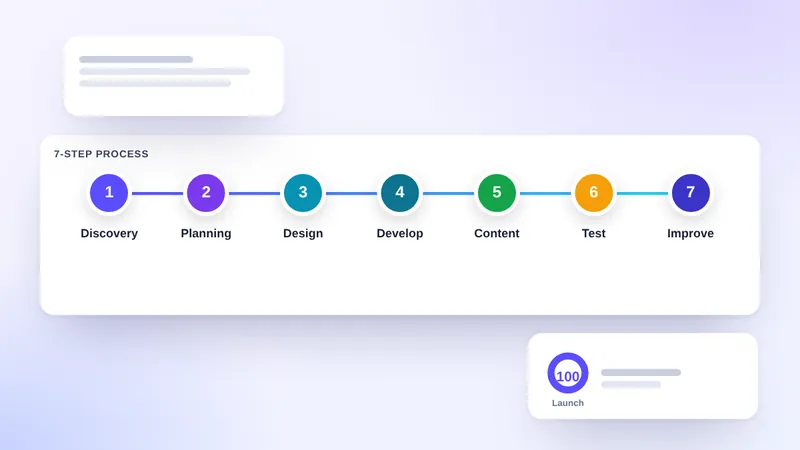
Plan content early. Waiting for copy is the most common reason website projects slip, and designing around real content produces better layouts than designing around placeholder text. Our website development process article walks through each stage in detail.
Choose the right platform and technology
There is no single best platform — only the best fit for your content, team and goals:
| Option | Best for | Trade-offs |
|---|---|---|
| WordPress | Content-rich sites edited by non-technical teams | Needs disciplined plugin use and regular updates |
| Shopify | Online stores that want reliable hosted commerce | Less flexibility for highly custom logic |
| React / Next.js | Interactive, app-like experiences and strict performance goals | Requires developer involvement for many changes |
| Laravel / custom | Sites with bespoke business logic, portals or integrations | Higher initial build effort |
| Static sites | Brochure sites where speed and security matter most | Content updates need a workflow or headless CMS |
If you're weighing a JavaScript framework against a more traditional build, read React vs traditional web development.
Design for users, accessibility and conversion
Good design guides attention. Use a clear visual hierarchy, generous whitespace and consistent components. Every page should answer three questions within seconds: what is this, why should I care, and what should I do next?
- Write headlines that describe outcomes, not just features.
- Place a primary call-to-action above the fold and repeat it at natural decision points.
- Support claims with proof: process, portfolio, case studies and genuine testimonials.
- Design for accessibility from the start — sufficient colour contrast, visible focus states, keyboard navigation and descriptive alt text.
Development: front end, back end and integrations
During development, designs become working pages. The front end covers HTML, CSS and JavaScript that run in the browser; the back end handles data, content management, forms and integrations with tools such as your CRM, email platform or payment gateway.
Quality practices matter more than any single technology: reusable components, version control, code review, automated checks and a staging environment where you can review changes before they go live.
Build SEO into the foundations
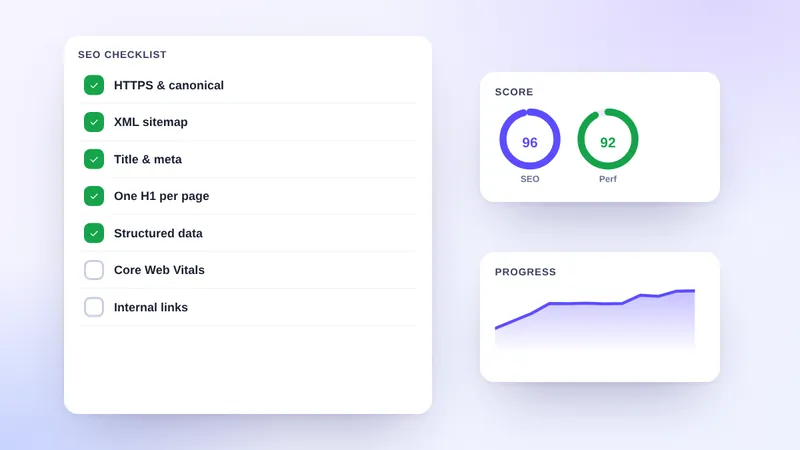
Search engine optimization is far cheaper to build in than to retrofit. Technical foundations include semantic HTML with one H1 per page, descriptive titles and meta descriptions, clean URLs, canonical tags, XML sitemaps, structured data and a logical internal linking structure.
Use our website SEO checklist before launch, and if you'd like expert help, see our SEO services.
Make performance a requirement, not an afterthought
Speed affects user experience, conversion rates and search visibility. Google's Core Web Vitals measure loading (LCP), responsiveness (INP) and visual stability (CLS). Set a performance budget early and hold the design and development to it.
The biggest wins usually come from modern image formats, fewer third-party scripts, efficient fonts and good caching — all covered in how to improve website speed.
Launch carefully
A good launch is boring — and that's the point. Before going live, test forms and integrations, check every template on real devices, validate metadata and structured data, set up analytics and Search Console, and map 301 redirects from any old URLs so you don't lose existing rankings.
Maintain and improve after launch
Websites are living products. Plan for software updates, security monitoring, backups and uptime checks — and for continuous improvement based on data. Review analytics monthly, watch which pages convert, and keep content current. A small, regular investment protects the much larger one you made in building the site.
How much does it cost, and how long does it take?
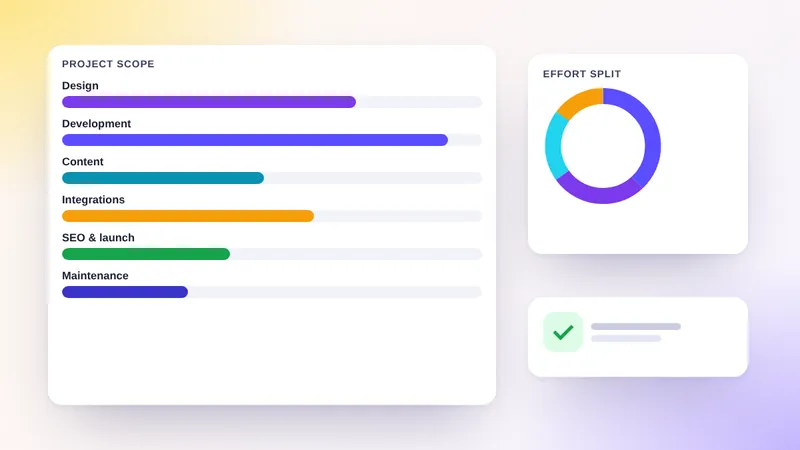
Cost and timeline depend on scope: the number of unique templates, the amount of content, custom functionality, integrations and the level of design detail. As a rough guide, a focused business website often takes 4–8 weeks, while sites with complex functionality take longer. For a breakdown of what drives cost, read how much does website development cost?